How to protect fast growing cities from failing

TALK

Robert Muggah, TED Talk, October 2014

So urban geographers and demographers, they tell us that it’s not necessarily the size or even the density of cities that predicts violence, no. Tokyo, with 35 million people, is one of the largest, and some might say safest, urban metropolises in the world. No, it’s the speed of urbanization that matters. I call this turbo-urbanization, and it’s one of the key drivers of fragility.

When you think about the incredible expansion of these cities, and you think about turbo-urbanization, think about Karachi. Karachi was about 500,000 people in 1947, a hustling, bustling city. Today, it’s 21 million people, and apart from accounting for three quarters of Pakistan’s GDP, it’s also one of the most violent cities in South Asia. Dhaka, Lagos, Kinshasa, these cities are now 40 times larger than they were in the 1950s.


To learn more about Robert Muggah, his work on evidence based urban policy and data visualisations, visit the Igarapé Institute here and SecDev here.

Ernest Zacharevic

ARTIST

ernestzacharevic.com

Barrel Of Monkeys, Kuching 2014

Kutching, the capital of Sarawak State on Borneo Island is found in the wild east of Malaysia.

Borneo is one of the last natural habitats for the Orangutans as well as being recognised as one of the most rapidly deforested areas in the world. These two just don’t go too well together…

For more street art by Ernest Zacharevic, click here.

Charles Montgomery talks “Happy City” with Mark Gorton

TALK

Mark Gorton, Street Films, 22 April 2014

We know that for much of the history of urban planning and architecture the people who build our cities, who build public spaces, who create buildings and city systems, often they will tell us they are building for our happiness, it’s the end goal of everything all of us do anyway, except they rarely provide evidence to demonstrate that they are making us happier with their creations. So I found this very curious, and looking at the last couple of decades of terrific work being done in neuroscience, behavioural economics and psychology, we’re actually starting to gain some evidence that tells us a little bit of the effect of the urban system on our our own well being, on how we feel and how we treat other people.


For see Charles Montgomery’s book Happy City: Transforming Our Lives Through Urban Design on Good Reads click here.

Why buses represent democracy in action

TALK

Enrique Peñalosa, TED Talk, September 2013

Mobility in developing world cities is a very peculiar challenge, because different from health or education or housing, it tends to get worse as societies become richer. Clearly, a unsustainable model. Mobility, as most other developing country problems, is more than a matter of money or technology, is a matter of equality – equity. The great inequality in developing countries makes it difficult to see, for example, that in terms of transport, an advanced city is not one where even the poor use cars, but rather one where even the rich use public transport, or bicycles.

New York’s streets? Not so mean anymore

TALK

Janette Sadik-Khan, TED, September 2013

And so, I think that the lesson that we have from New York is that it’s possible to change your streets quickly, it’s not expensive, it can provide immediate benefits, and it can be quite popular. You just need to reimagine your streets. They’re hidden in plain sight.


To learn more about Janette Sadik-Khan’s work on streets and transportation, click here.

AD Classics: Ville Radieuse / Le Corbusier

ARTICLE

Arch Daily, 11 August, 2013

In accordance with modernist ideals of progress (which encouraged the annihilation of tradition), The Radiant City was to emerge from a tabula rasa: it was to be built on nothing less than the grounds of demolished vernacular European cities. The new city would contain prefabricated and identical high-density skyscrapers, spread across a vast green area and arranged in a Cartesian grid, allowing the city to function as a “living machine.” Le Corbusier explains: “The city of today is a dying thing because its planning is not in the proportion of geometrical one fourth. The result of a true geometrical lay-out is repetition, The result of repetition is a standard. The perfect form.”


For images and information on Le Corbusier’s architectural projects on the UNESCO World Heritage List click here. See also Citizen Jane: The Battle for the City, The Human Scale and The Pruitt-Igoe Myth.

The Human Scale

FILM

Andreas Dalsgaard, Final Cut for Real, 2013

I guess there is this very difficult tradition, which comes from the way we teach architecture and planning, the idea that one person can solve everything. And we even have this term ‘The Masterplan’, like ‘I’m going to do The Masterplan’, which will answer all questions. And of course we know it’s impossible, cities are unbelievably complex, so even the idea of a masterplan is really crazy.  All we can do is make a kind of a framework, we came make a very robust framework which allows life to take place. 

What they needed was investment in their children. What they needed was safer streets. What they got? A monorail.

Edward Glaeser, economist (on Detroit)

The Triumph of the City

BOOK

Edward L. Glaeser, Penguin Press, 2011

Cities, the dense agglomerations that dot the globe, have been engines of innovation since Plato and Socrates bickered in an Athenian marketplace. The streets of Florence gave us the Renaissance, and the streets of Birmingham gave us the Industrial Revolution. The great prosperity of contemporary London and Bangalore and Tokyo comes from their ability to produce new thinking. Wandering these cities—whether down cobblestone sidewalks or grid-cutting cross streets, around roundabouts or under freeways—is to study nothing less than human progress.


For a talk by Edward Glaeser at UC San Diego summarising this book click here. For a discussion of Glaeser’s work on eliminating barriers to innovation for food trucks by The Urbanist, Alan Davies click here.

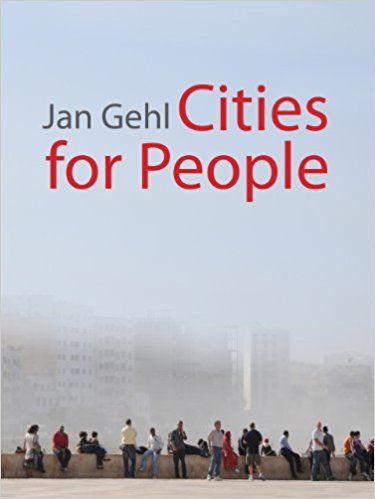
Cities for People

BOOK

Jan Gehl, Island Press, 2010

Now, after many years, a great deal of knowledge has been amassed on the connection between physical form and human behavior. We have extensive information about what can and should be done. At the same time cities and their residents have become very active in crying out for people-oriented city planning. In recent years many cities in all parts of the world have made a serious effort to realize the dream of better cities for people. Many inspiring projects and visionary city strategies point in new directions after years of neglect.


James Corner – Reshaping Cities

SHORT FILM

Monocle, 9 July 2010

What’s great about this now is that it’s a great model for other cities across the country, who are beginning to think that maybe high quality design of public space isn’t something that comes after the fact, but is maybe something that we invest in now, in order to spur significant economic development and ensure a higher quality of urban life.


To visit the Field Operations website click here.